
By Sarah Nugent
Day 1 - The Plesiosaur
I walked into the museum’s Collection Resource Centre (CRC) in Swords, north County Dublin, on my first day of work experience, Friday the 27th of March 2026 with high hopes. As a student with an interest in geology and mineralogy, working in the geology collections sounded like a dream come true. It’s safe to say my high expectations were very quickly surpassed. I was delighted to meet curator Patrick Roycroft who enthusiastically told me all about different specimens in the museum and the very exciting possibility of a new plesiosaur being discovered that very day in the museum. German researchers Sven Sachs and Katrin Sachs were visiting to view the museum’s collections on their world tour to discover new species of marine reptiles from forgotten/mislabelled specimens hidden away in museum collections. I was shown the plesiosaur and why they thought it was something new. (If my memory serves me correctly, oddly shaped flippers). After an exciting tour during which I saw orbicular granite, a large piece of fluorite, the sadly dismantled Rhomaleosaurus (which I had seen a cast of in the Natural History Museum of London only a few weeks previously, making it extra spellbinding to see the real deal) along with many more fascinating things I won’t list here for fear of keeping the reader all day, and a cup of tea in the canteen with Patrick and the Sachs’, I was given my first task. This was to write new labels for various specimens which had old labels that were often falling apart or becoming difficult to read. This was very interesting as I got to see a cohort of rocks and minerals and where they had been found. At the end of the day, Dr Sachs confirmed that we did indeed have a new species of plesiosaur. Leaving me with the great memory and thrill that comes with being present for such a discovery.
Day 2 - Cotterite
The next Friday I returned to the CRC with the knowledge that it would likely not be as exciting as last week after the great discovery. However, that didn’t mean I wasn’t very much looking forward to my return and what Patrick would have in store for me. Sure enough, I was not disappointed. I was trusted to do more label transcriptions, which allowed me to see fascinating rocks and minerals from all over the world, from Pompeii (Italy) to Iceland and even Australia, Japan, and America. At the end of the day, Patrick gave me the privilege of seeing the fabled mineral cotterite. This was very exciting: not only is it a type of quartz (one of my top three favourite minerals, along with realgar and malachite) but it has also only ever been found in one locality - Rockforest, Co. Cork. He informed me of what makes it so special, the pearly lustre that is given to it by separating laminae and the fact that there are only around 34 specimens in the world! I was honoured to be given the opportunity to hold a specimen of this captivating mineral and it had very much piqued my interest. Patrick also told me that he had a video about cotterite on Youtube. So, after chatting to my dad about it all the way home I decided to sit down and watch this video. I also managed to force my parents and sister to watch it with me, so they could see a glimpse of what I got to see at work. In the video, topics such as the composition of the mineral and its finder Grace Cotter were covered in this informative video. You can imagine the surprise and elation in the room from descendants of the La Touche family when Patrick brought up Grace Cotter’s family tree, which had the name ‘La Touche’ on it. This was part of my family! The video was immediately paused and examined to see just what was going on here. My dad brought out a book, which we had lying about the house on the La Touches, and managed to create a ‘geological’ family tree (turns out it runs in the family), including Grace Cotter which led us to the conclusion that Grace Cotter was my 3rd cousin 5 times removed!! What a coincidence!
Day 3 - Zeolites and the family tree
The very next week I arrived in CRC once again, bringing with me my dad’s family tree and the La Touche book. In the morning, Patrick told me my task this week would be a little different and that, as opposed to transcribing labels, I would be ensuring minerals were on the correct shelf and in the right drawers, taking note of those that weren’t on a special sheet, which had the specimen numbers and where they should be, along with a column for whether they were there or not. I admit that I was slightly confused by this task. While Patrick went to get some zeolite minerals which were the first group I was checking, I took the family tree and book out of my bag. I explained to him my dad had made a geological family tree, which he seemed to find amusing, and a little confusing at first, as to why I was showing him this. However, he looked over it anyway and quickly realised the connection to cotterite! After some discussion of how we figured it out and what the exact relation was between myself and Miss Cotter, I was left to return to the task at hand and Patrick to his work. After the first drawer, Patrick informed me that I hadn’t quite done what I was supposed to and patiently redirected me. After this, I was able to actually do what I was meant to be doing all along and see some fascinating minerals at the same time. I got to see the nearly extinct mazzerite from France, stilbites from India, red stilbites (which I never knew existed until that day) from Canada, and many more that I once again won’t list here for the purpose of time. At the end of the day, my dad came to collect me, and we discussed the great discovery together before leaving.
Day 4 - La Touches in the museum
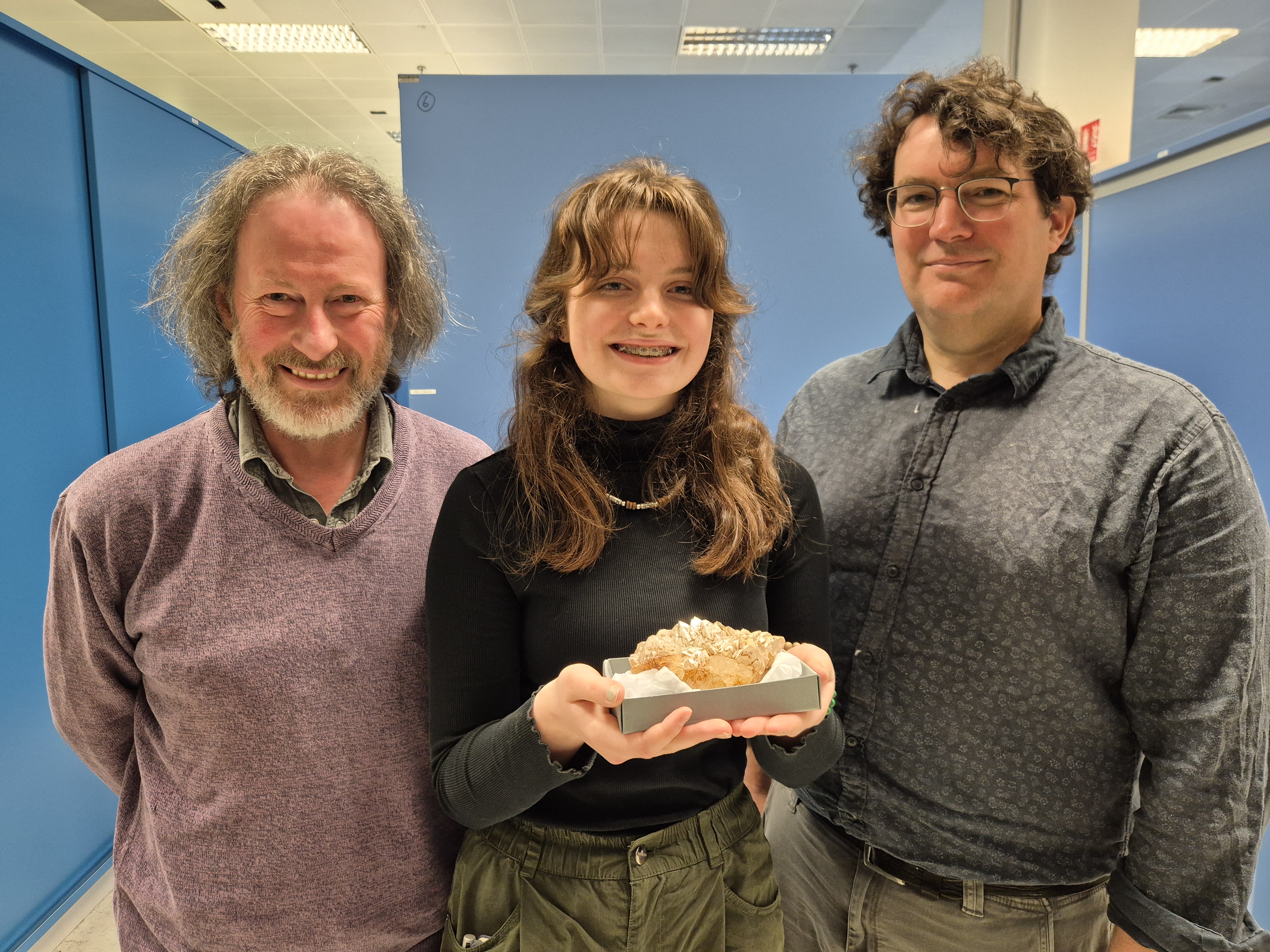
On Friday April 24th, my dad came to have tea with Patrick and I to discuss La Touche connections to the museum and to cotterite. We discussed my great-great-grandfather John La Touche who was an ornithologist and studied the birds of eastern China extensively. He also donated some taxidermied bird specimens to the museum. We also discussed James La Touche who wrote a book on the geology of Shropshire. All of this and more led Patrick to enquire about our interest in creating a La Touche exhibition in the Dead Zoo Lab in Collins’ Barracks, Dublin: of course, we were very enthused by this idea, causing my dad to contact his distant cousin Gareth La Touche later in the day. After tea and coffee, Patrick asked some of his work colleagues (curator Emma Murphy and temporary staffer James Maxwell) to help with a small photography session: they agreed to take some photos of the three of us with the cotterite, and just me and the cotterite for Patrick's own blog post, and an entry in a quartz special of the geological journal Elements. After an action-packed morning it was back to work for everyone, including me. Once again, I was ensuring minerals were in their correct locations, except this time I was dealing with labradorites instead of zeolites. I saw specimens from Norway, Iceland, Vesuvius (Italy), Germany, the Faroe Islands, and more. I saw a variety of other minerals: thomsonite, orthoclase, heulandite, oligoclase and on and on and on. All of them different colours, including a special favourite of mine, a blue and green orthoclase from Norway, which reminded me of the wing of a dragonfly.
Day 5 - The rock collection, Oxford St. and Antrim
On this day (May 1st) I had decided to bring a few confusing and interesting specimens from my personal rock collection to show and ask Patrick about. He enthusiastically told me his theories of what they could be and his reasoning for thinking thus. I really enjoyed getting the professional analysis of what I could really only guess at, and learn a lot from 4 rocks I had on my shelf at home. After this, it was back to categorising minerals as I had done for the last 2 weeks. That day, I was looking at harmatome specimens. Once again, there was huge variety among the minerals and where they came from. At the end of the day, Patrick showed me some grey coloured chalk (which I had never seen before) from under Oxford St. in London. Having been to Oxford Street in the past it was delightful to see what thousands of people walk over every day without a second thought. After that, Patrick invited me to look through the minerals of Antrim drawers, without needing to work but just examine and appreciate the minerals. There was quartz, flint, yellow calcite, gmelinite, mesolite, and natrolite! Who knew one county could hold so much mineralogical interest!!!
Day 6 - Presents, Donegal and Cork
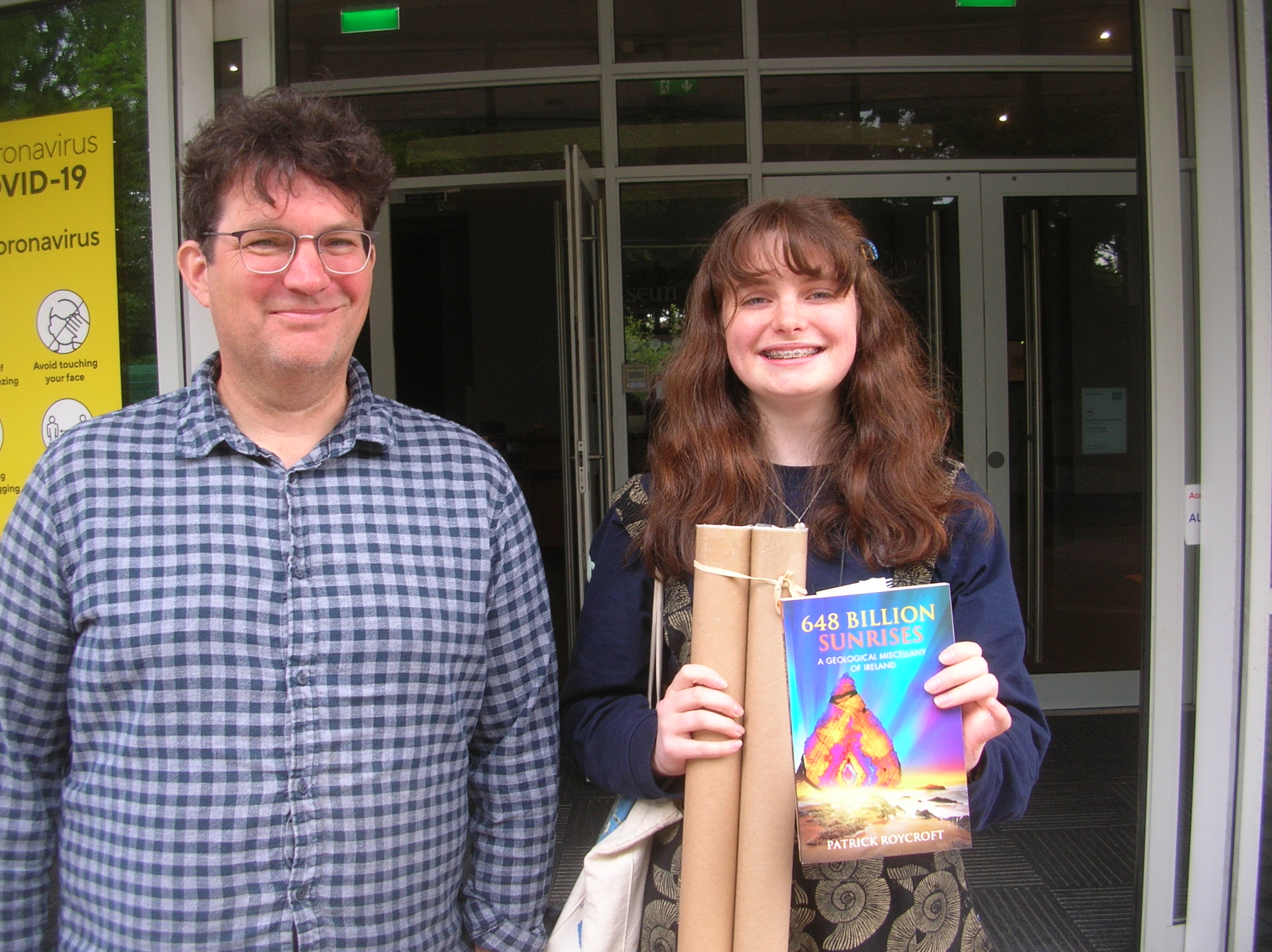
My final day at the museum rolled by extraordinarily quickly! I couldn’t quite believe that in a few more hours it would all be over. I arrived that morning with a small gift for Patrick, to say thanks for all the time he gave me and hosting me at the museum. Little did I know he had presents for me, too! But more on that later; for now, it was back to work. Except that seeing as it was my last day Patrick allowed me to look through the drawers of whatever counties I pleased and check if they were mentioned in the ‘MBI’ (Minerals of Britain and Ireland book by Andrew Tindle). I decided to start with Donegal, because I have spent many weeks up there on my holidays over the years. There was a wonderful variety: beryl from Sheskinarone, orthoclase, calcite, tourmaline, garnet, vesuvianite, and even donegalite! Which I had never known existed. There were many more, almost all of which were mentioned in the MBI but are, I think, too numerous to list here. After this I moved on to Cork, my mum’s home county and also the home of cotterite. I was given a final look at the stunning cotterite and also saw baryte, chlorite, azurite, chalcopyrite, and more. Patrick also showed me some huge amethyst pieces from an old secret mine (hidden by a crafty jeweller) in Blackrock, Cork. I couldn't believe it when he said Blackrock. Why? Because that is where my Mum grew up! It seems I was destined to end up in the museum with family connections on both sides. Sadly, my time at the museum was coming to an end. However, remember the presents from earlier? Patrick had one last surprise before I left. You can imagine my great excitement when he gave me a signed copy of his book and not only a map of the rocks of Ireland but also one of the minerals!!!! I was ecstatic. After this we walked out into the reception area and waved our goodbyes. Me and my dad drove back to Meath but vowed to keep in touch with Patrick and hopefully continue the development of the La Touche exhibition.
For enquiries about Transition Year placements or university internships with the Natural History Division, please e-mail naturalhistory@museum.ie
Further Information:
Cotterite video: Cotterite - The World’s Rarest form of Quartz
Cotterite in Elements journal: Parting Shots - Elements Magazine
La Touche book: La Touche Family in Ireland, by Michael McGinley (2004)
The Dead Zoo lab at the National Museum of Ireland, Collins Barracks: