By Sylviane Vaucheret, Collections Resource Centre Manager, National Museum of Ireland
What is “Re-Org”?
The Re-Org method was developed by the International Centre for the Study of the Preservation and Restoration of Cultural Property (ICCROM), based in Italy. The aim of Re-Org is to help museums improve and optimise their existing collections storage areas. The history and development of Re-Org is very well explained on ICCROM’s website and rather than repeating this information, we will describe how the Re-Org methodology was applied in the Collections Resource Centre at the National Museum of Ireland.
The Collections Resource Centre
The Collections Resource Centre is an off-site building where the majority of the objects from the National Collections are kept in storage. The building houses collections which are not on display, and is accessible to researchers by appointment only. Some of the objects in storage have been taken off display for various reasons, or might go on display in the future. The larger objects in the national collections are cared for in the Collections Resource Centre. It also operates as a logistics hub in the absence of large exhibition spaces for them. Other objects might never be displayed and are held in the care of the National Museum of Ireland for research purposes, or as historical or scientific records for future generations.
The National Museum of Ireland acquired the Collections Resource Centre in 2008, at the start of a severe economic recession. A 21,000 square-metre building, the Collections Resource Centre could not entirely be fitted out with shelving and other storage furniture at the time, and many objects were stored on pallets. Over time, the building filled-up, collections spaces became more crowded, and objects less accessible.
Why Re-Org?
In 2025 the Collections Resource Centre’s team decided that it was time to improve the storage of the “Arts and Industry” objects in the collections (this collection is also commonly referred to as “Decorative Arts and History, and a selection of it is on display in Collins Barracks). Generating additional capacity in storage for our colleagues in the Arts and Industry curatorial team has become essential at this stage to support the development of the Changing Ireland gallery in Collins Barracks.
We discovered the Re-Org methodology online. We were attracted to its structured and holistic approach, as well as it proven record, having been used by over 200 cultural institutions worldwide.
From ICCROM’s website, we download the “Re-Org method kit”. The kit is available in several languages reflecting the truly international nature of museum collections storage challenges! The Re-Org methodology is also very flexible. It can be adapted to storage areas of any size and to projects of any budgets, allowing it to be used across the museum sector.
Four documents are included in the kit:
- The “Self-evaluation tool”, which helped us confirm that we needed a “Re-Org” project and identify which aspects of our storage arrangements needed extra focus (more on this to follow).
- The “Workbook”, which describes the Re-Org methodology as a step-by-step set of instructions. These allowed us to have a systematic approach and not to overlook aspects of collections storage which could be easily missed.
- The “Worksheets”, which provided templates to record all the required information at each stage of the project.
- An extremely useful “Additional Resources” document, with concrete examples, possible scenarios and great “tips and tricks”.
Re-Org provided us with a really useful step-by step approach. With museum collection storage projects, it is easy not to know where to start, to get side-tracked or to miss important aspects of the collection or the storage environment. Re-Org’s methodical and systematic approach allowed us to make informed decisions based on data, and to be confident we did not overlook anything. It also provided templates to gather and record all the information, which greatly facilitated communication with external and internal stakeholders.
Using the Workbook, we collaborated with colleagues from the Arts and Industry curatorial division, from the Conservation Department, from the Estates team and from our own Registration Department to gather all the necessary information and compile an accurate assessment of our storage needs.
Why Re-Org worked for us?
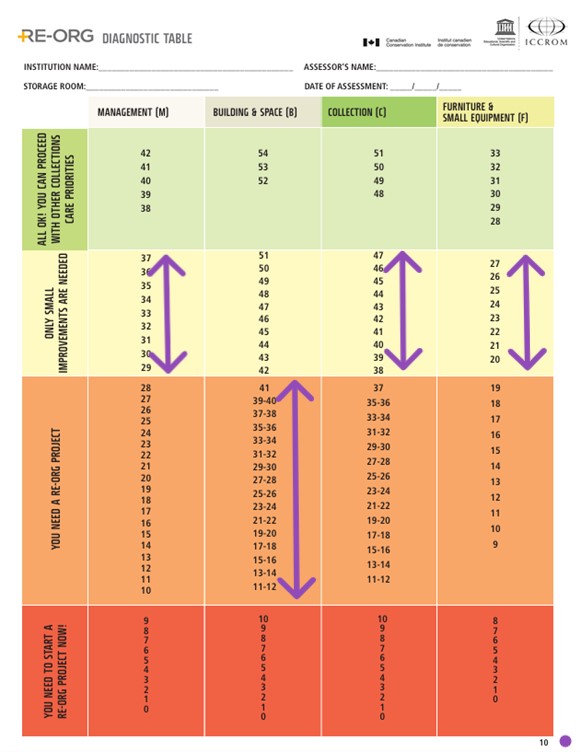
Our results on the Re-Org Self-Evaluation tool gave us a clear path forward (see diagnostic table in carousel below).
Evaluation and Preparation phase
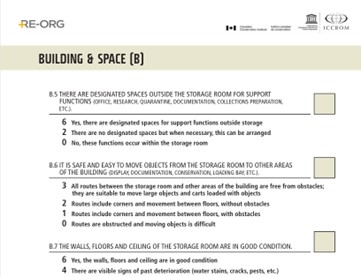
Because the Collections Resource Centre is such a large building, we found it more effective to apply the Re-Org methodology to one storage area at a time. We used the “Self-Evaluation” tool to assess our “Arts and Industry” storage space in early 2025. The results were reassuring, indicating that only small improvements were needed under three of the components (“Collection”, “Furniture and Equipment”, and “Management”). However, our “Building and Space” section fell within the “You need a Re-Org” category.
The main priorities for improvements identified through the initial questionnaire were:
- Addressing the risk caused by plumbing infrastructures located above collections.
- Improving routes for objects from the store to other parts of the building.
- Removing non-collection items from the collection’s storage area.
- Removing items and objects stored within aisles, or between shelving.
Having identified the top-priority issues, we went about completing the Re-Org “Workbook” and “Worksheets”. These documents contain thematic surveys. The Workbook describes how to conduct each of the surveys. The worksheets -in the form of tables or pre-filled texts- provide a centralised place to record the data. At the end, a pre-filled storage condition report template guided us though a thorough analysis of the raw data and helped us draw informed conclusions.
This phase of a Re-Org project should not be underestimated, and it took a team of two, about 9 months to complete (fitting this is amongst many other tasks, it must be said).
The result was a 17-page Storage Condition Report detailing the issues identified under each of the four components, the proposed actions to remedy them, the resources required, and a project chart to track progress. This document provides a strong framework for drawing up a business case for the overall project if necessary.
Armed with the report, we were able to seek some of the additional resources identified and launched the implementation phase.
Implementation phase
There were many strands to the implementation phase. Thankfully they could be run at the same time. We started implementation in June 2025 and finished in June 2026.
- Under the Building and Space component, which we had identified as our most problematic component:
- We put in place a programme of work, with the support of the Office of Public Works (OPW), to remove any plumbing equipment near or above collection objects. This programme is now completed, and we are confident that the risk of water damage to our objects has been eliminated.
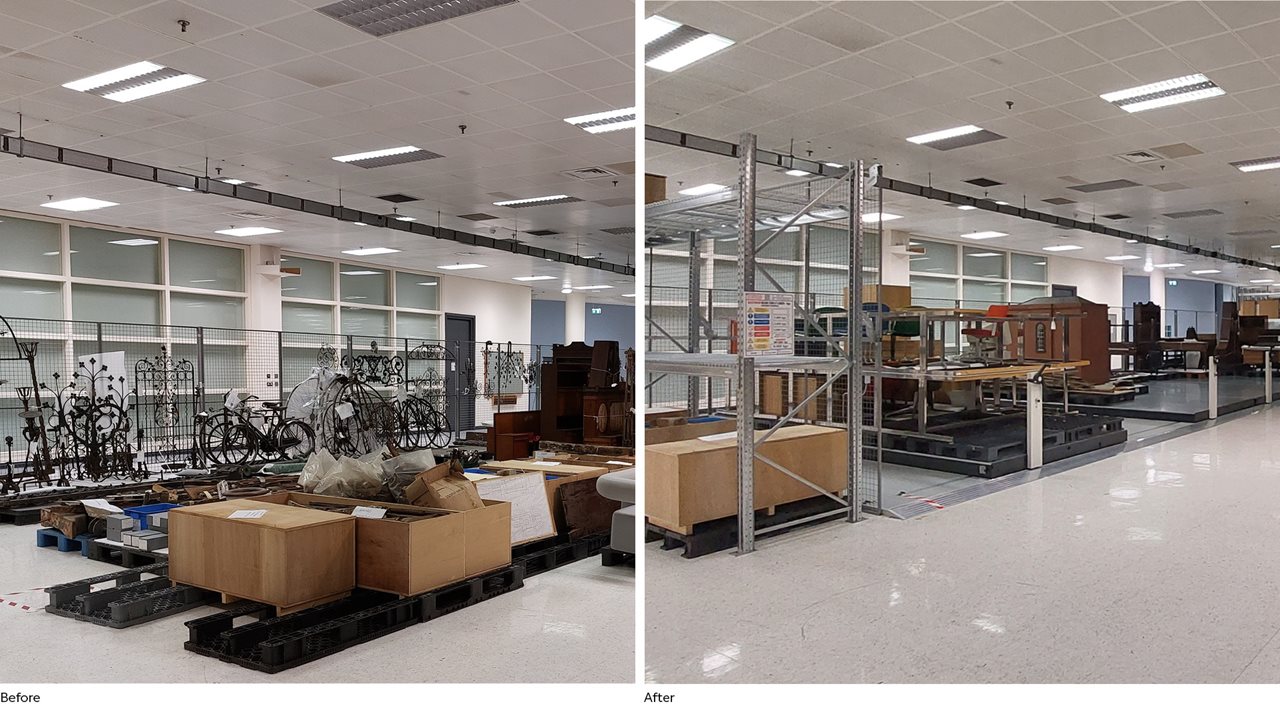
- We removed all non-collection items from collection spaces, removing clutter and improving accessibility to the objects.
- We identified that moving objects from the storage areas currently involves some turns and corners. This was important to acknowledge and will be kept in mind for any future modifications to the lay-out of the storage areas.
- Under the Furniture and Equipment component:
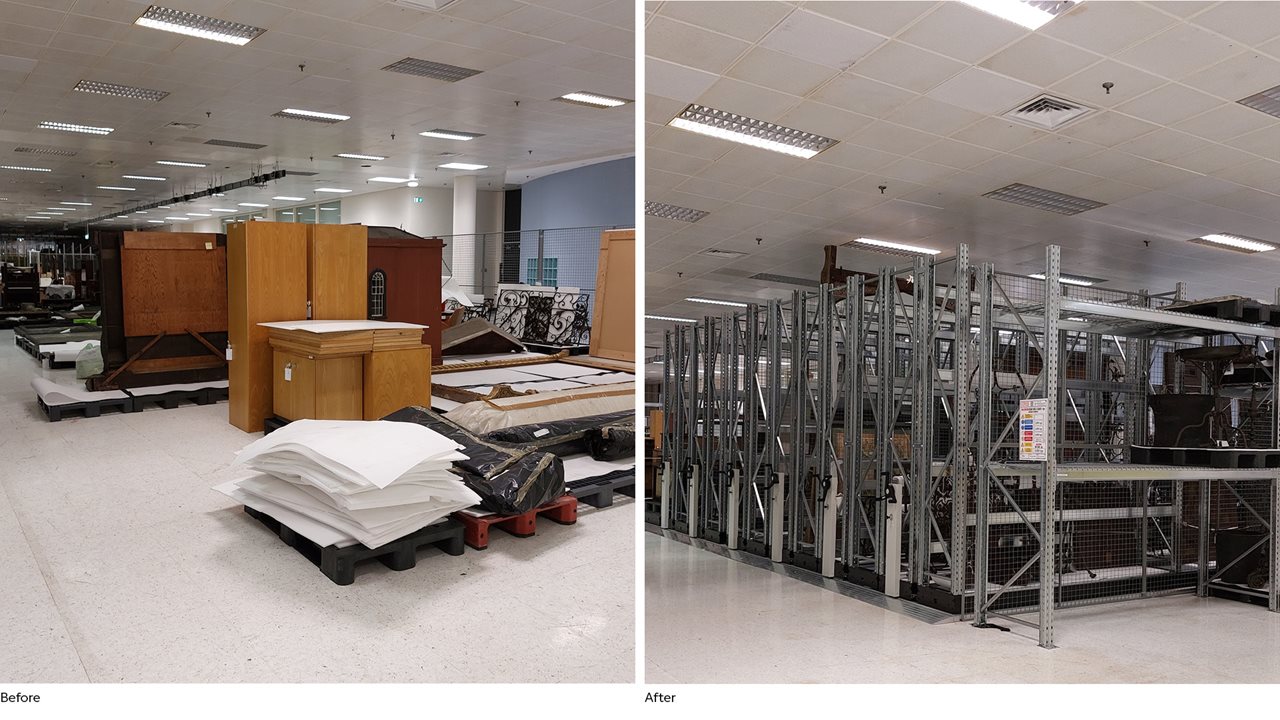
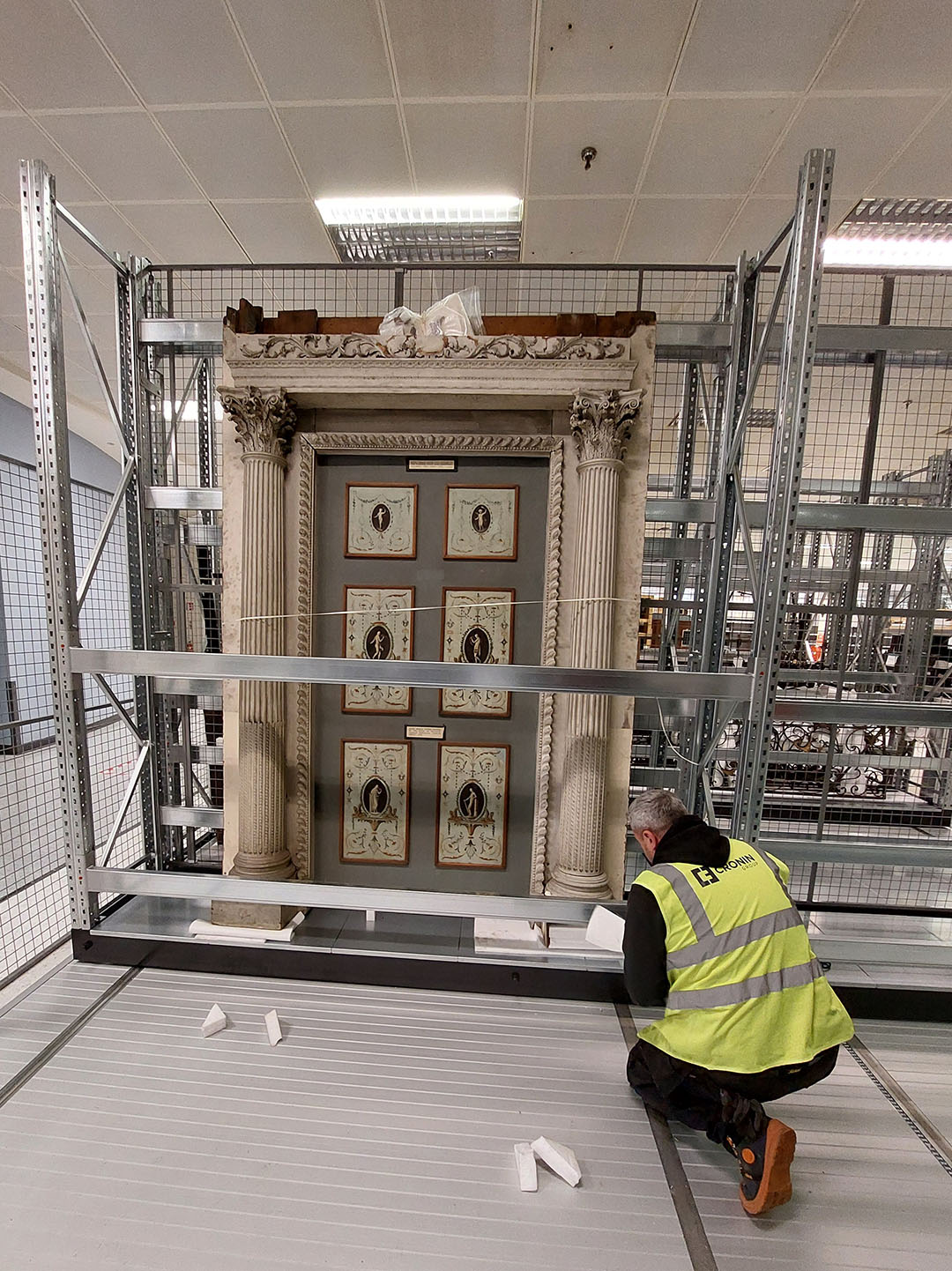
- Joining force with our shelving provider, Storage Systems, we designed storage solutions for all the objects which could be lifted off the floor. For instance, some large, flat objects (doors, mirrors, frames) are now stored vertically to take full advantage of the 4-metre ceiling height within the store.
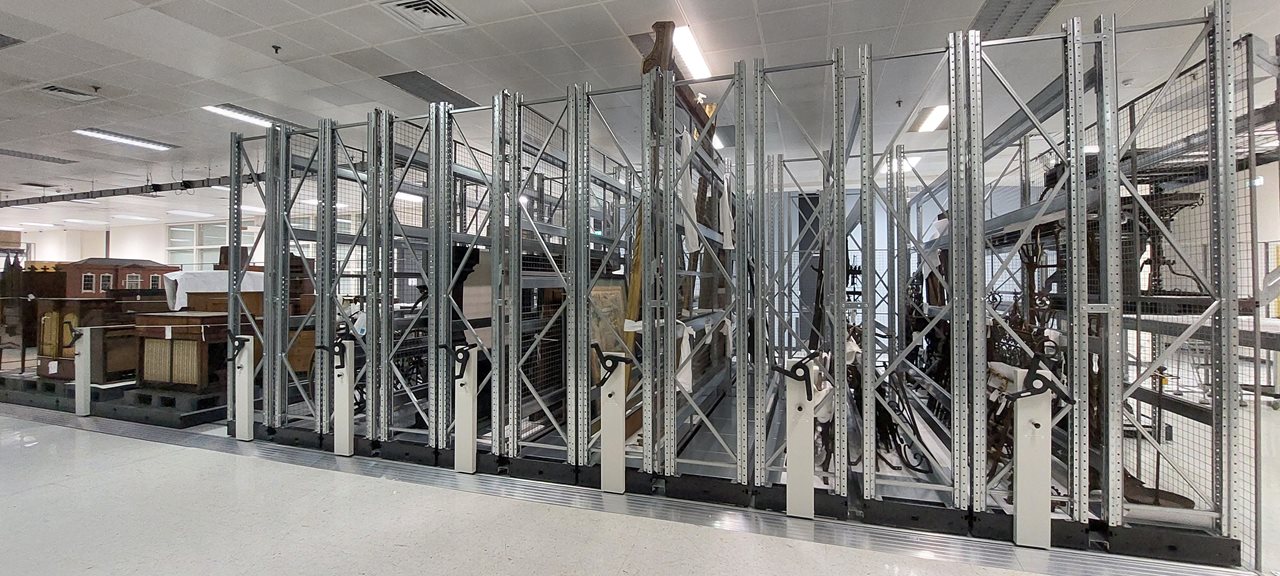
- We installed mobile platforms for the majority of the large objects, maximising our floor occupancy and providing access to each object.
- Under the Collection component:
- About 300 large objects, previously stored on pallets without detailed storage location information are now stored on fully coded shelving platforms allowing for easy retrieval.
- We committed to start recording the weight and dimensions of all objects moving in or out of storage. This will help make future move planning easier and more efficient.
- We identified a dozen objects without labels, which are being actively researched so that they can be re-associated with their accession information.
- Under the Management component:
- We purchased dedicated cleaning equipment and put in place a cleaning schedule for the collection spaces.
- We put in place a schedule of regular collection audits, confirming the location of randomly selected objects and carrying out physical inspections.
- We set-out to write down procedures for routine practices by existing staff that were not formally captured before.
- We acknowledged that research visits could not follow absolute best practice given the fit out of our facility (no “reading room”), but that they were as safe and secure as could be organised within our existing resources.
How Re-Org worked for us?
We found Re-Org a real wealth of information about best practice in museum storage. The systematic approach of the workbook gave us real confidence that no aspect of collection storage was overlooked. The scoring and recording systems within the Re-Org method also really helped us prioritise the issues objectively. Re-Org was like a virtual expert advisor who informed, guided, and encouraged us every step of the way!
As an added benefit, our Re-Org project definitely helped us prepare for an upcoming inspection by the Heritage Council, to renew our MSPI (Museum Standards Programme for Ireland) accreditation.
If you are thinking about using Re-Org in your own organisation, we would absolutely encourage you to give it a try. We are planning to use it again for all our future improvement projects, as well as for planning new storage areas.
However, a few words of advice: Do not underestimate the amount of time which will be spent on the preparation phase. This is really important for making the most of the Re-Org method, during the implementation phase. We also found that the Re-Org templates could be fiddly to work with and would recommend converting them into the latest version of office software which you are currently using, before opening them.
We would love to hear from other institutions, especially in Ireland, who might be on a similar Re-Org journey. If this is you, please reach out!
More Information
To read more about the CRC see my colleague Kate Moriarty’s article about the CRC: Aladdin’s Cave | National Museum of Ireland
Acknowledgements
Thanks to colleagues Tim Heanue, Kate Moriarty, Sandra Heise, Edith Andrees, Brenda Malone, Jennifer Stapleton, Karena Morton, Ryan Koenig, Sophie Scally and Emer Ni Cheallaigh for their contributions to this project.
Thanks also to our external partners Storage Systems, and William Tracey & Sons (part of the Cronin group) for their valuable collaborations.