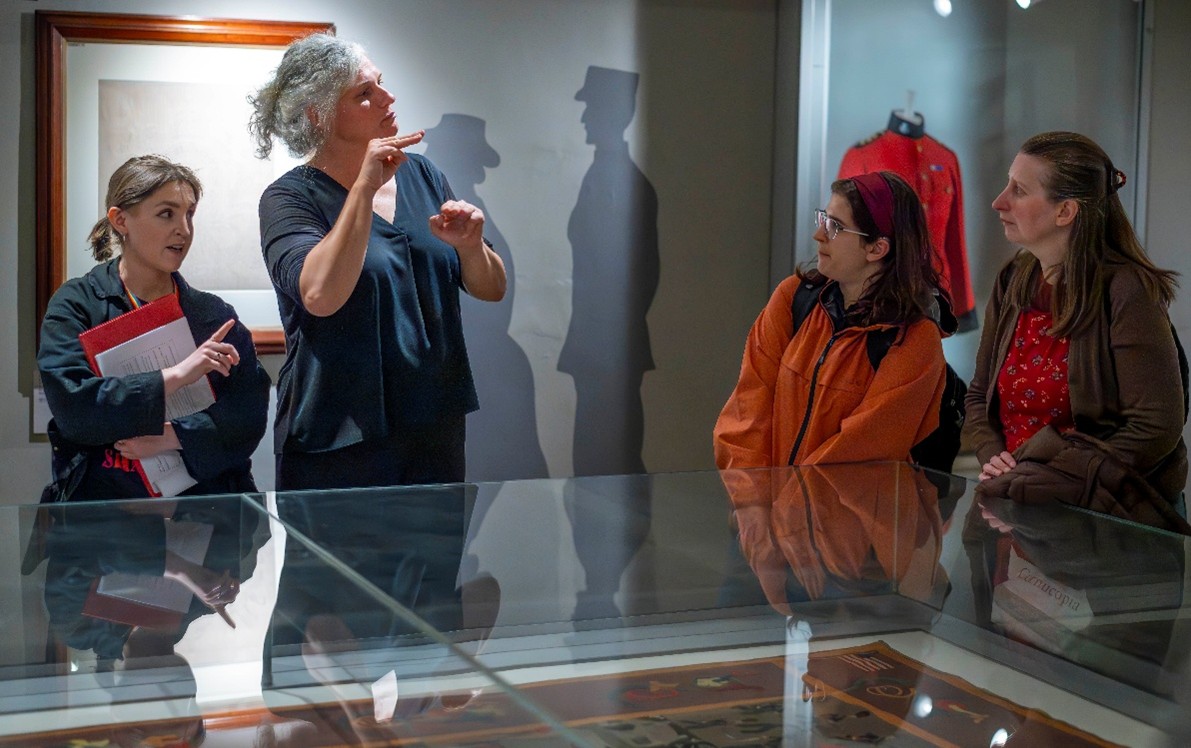
On Saturday 24th May 2025, the National Museum of Ireland launched a new LGBTQIA+ tour to mark the 10th Anniversary of the Marriage Equality Referendum, which was passed in May 2015.
This guided LGBTQIA+ tour views the exhibitions through alternative lenses, bringing some hidden histories and perspectives to the fore. Focusing on objects and individuals from the 17th to the 21st century, the tour reveals a wide variety of identities, genders and sexualities along the way.
Eve Gilsenan is an Education Assistant at the National Museum of Ireland, Collins Barracks, who had the opportunity to sit down for a chat with the Museum’s LGBTQIA+ tour researcher, Dr El Reid Buckley (ER-B), and Diarmuid Bolger (DB), Assistant Education Officer at Collins Barracks. We talked about the Museum’s vision and purpose for this LGBTQIA+ tour, challenges and opportunities encountered and feedback received.
EG: To start, it'd be great if you could both give me just a short introduction about your involvement with this LGBTQIA+ tour and your background.
ER-B: I was the researcher on the tour, and my background is kind of strange, but its Irish Studies, broadly. My BA and Masters were in English and Film Studies, and then I did a PhD in Sociology. I’m now a researcher in human-computer interaction. I've done a lot of artistic and socially-engaged research. I’ve developed a queer tour for Limerick City along with John Logan and Anna Blair…I’ve just been doing very much community-based projects all the way throughout.
DB: My background is that I am a historian and when I left college, I got a job working here in the National Museum as a freelance tour guide. So, I did that for three years and then went from there to work in the education department and I'm now the assistant education officer and manage the guides’ panel. One key part of my job here is not only managing the tour guides, but also then creating all the new tours that are developed, so hence why I got involved in this LGBTQIA+ project.
EG: Diarmuid- Where did the idea for the tour come from? Can you remember when it first started to be talked about in the education department?
DB: We'd been interested for a while in looking at expanding our tour collection. Looking at how can you tell bigger stories like, say, the history of food or the history of sport or clothing through our collections. And I think as well, the museum was looking a lot more at ensuring everyone's story is told and that we're a space where everyone can see themselves. In that context, we've wanted for a long time to create a tour that was exploring LGBTQIA+ history. In 2019 just after I started, we ran a half-day conference exploring collecting LGBTQIA+ history. The same year, the Museum created a temporary exhibition called 'Rainbow Revolution', which displayed artefacts that discussed some of the most memorable moments in the LGBTQIA+ movement in recent years, including Panti Bliss's Nobel Call Dress. We also created a trail, called 'The Rainbow Trail', where visitors could explore artefacts in the Museum connected to LGBTQIA+ history. The Museum has also hosted the Mother Block Pride Party onsite at Collins Barracks since 2019. There’s been a recognition within our team that this history has been overlooked and marginalised and we wanted to bring this back from the margins, as it were.
“We knew that the 10th anniversary of marriage equality was going on, so we said, that's a really good basis, let's aim for that, let's have this tour ready. So when the marriage quality anniversary comes, we have this tour.”
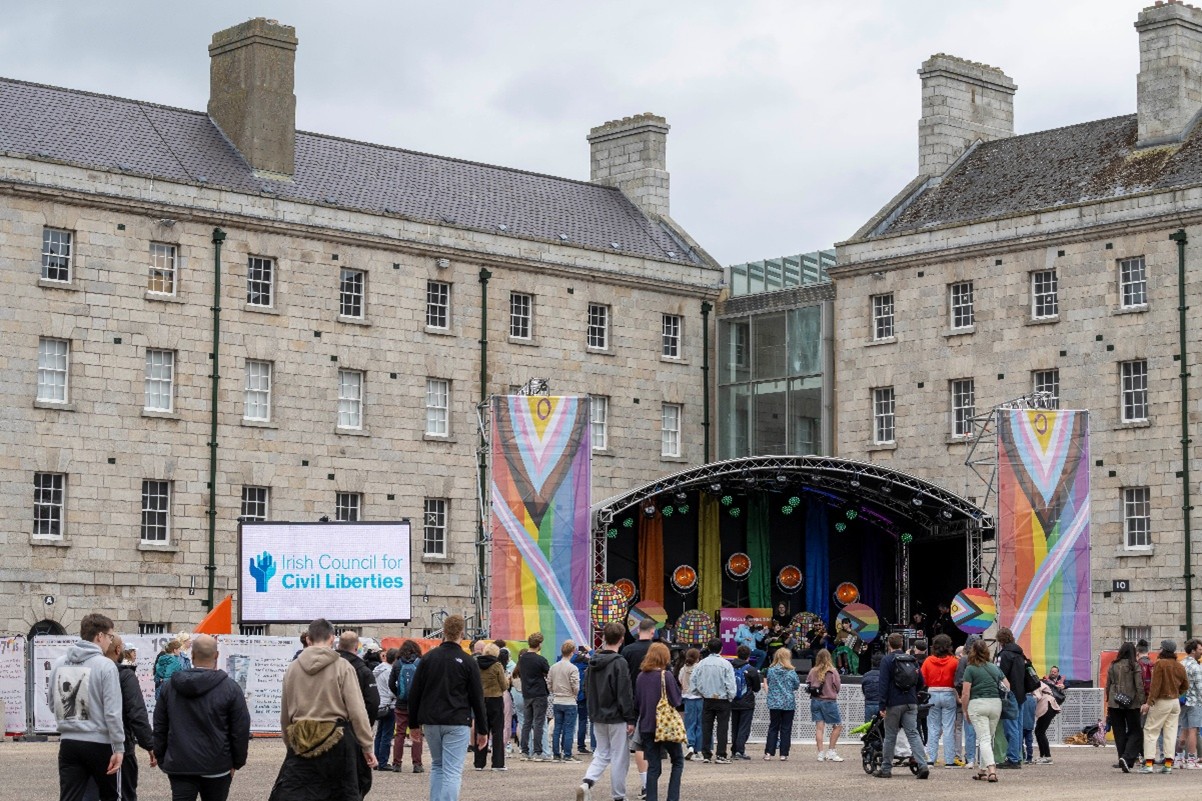.jpg "What-A-Difference-A-Day-Made-(2).jpg")
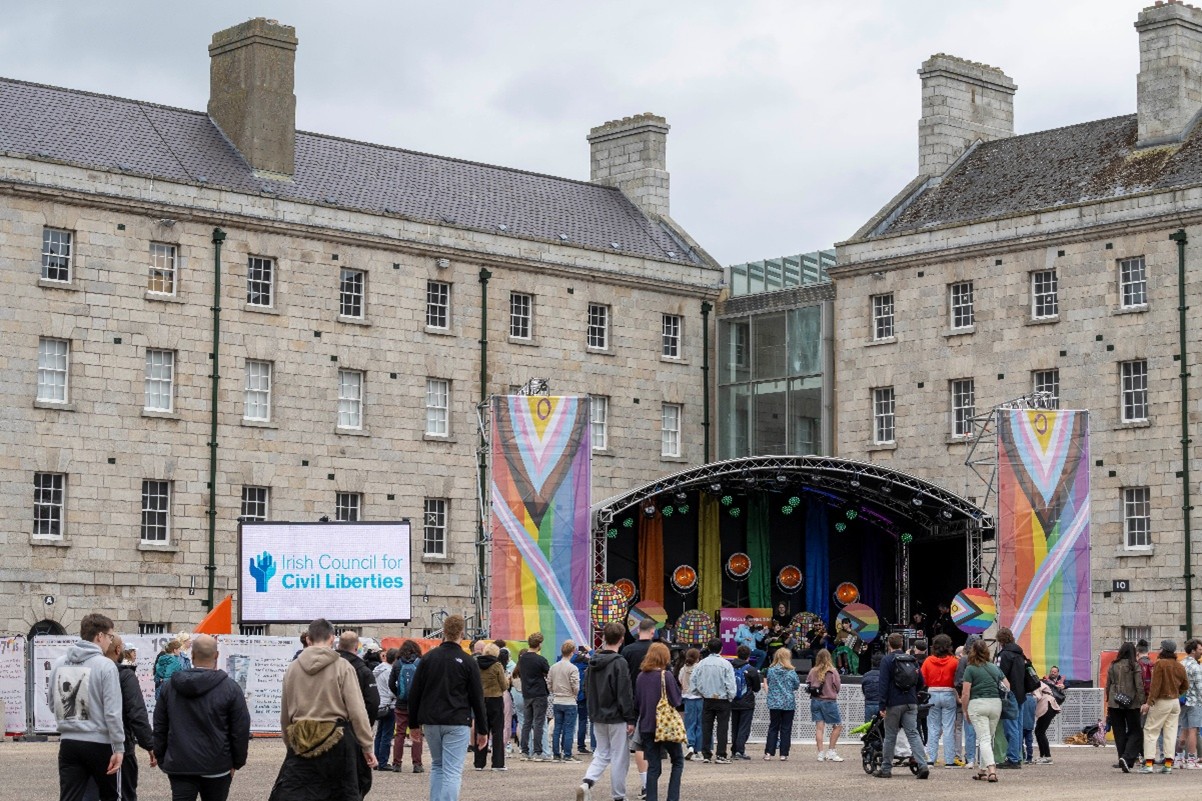
Crowd and stage in Clarke Square, Collins Barracks during What A Difference A Day Made event 2025
“We very much wanted to work with that policy of nothing about us without us.”
EG: El, could you tell us a little bit about why you applied for this and what piqued your interest?
ER-B: It was something that I hadn't seen at all, and then two days before the deadline, Dr. David O'Mullane from DCU sent it to me and said: I think you'd be really great at this. I didn't know if I would have the experience, but I wanted to be back in a research environment, so I put in an application. I was delighted to be asked to be a part of it then [after the interview process]. It was great to have you and Helen guide me in developing the tour. When we were doing it for the Limerick walking tour, we were all thinking about space and history and social relations together. And I think having the advisory panel that was devised by Helen Beaumont [Manager of the Learning team] and yourself, and having people feed in was really useful too. It was nice to be able to hear people's different perspectives of what their Ireland looks like, or their queer Irish history, because it does look different to everyone.
DB: That's an important thing that El touched on with the advisory committee that we wanted to ensure that the community was involved in this. We set up a panel of people, because we wanted to make sure that the community was being represented, so every step that we had, they were heavily involved in helping us create the brief for a researcher, helping us design when we had drafts together, or later on, when we were trialling the tour.
Please see full list of acknowledgements for this project here.
EG: When it came to designing the tour, what was the biggest challenge you found in choosing the objects? What did you want to get from the collection, for the tour?
ER-B: I think it was great to have the Rainbow Trail there, because you could already see that there was a scaffolding. But I think if anyone else did this tour, they would have done it completely differently. I think every single person is going to tell a different kind of story. I did want to go into it in a very exploratory way, and brainstorm about the interesting histories that I find that are often hidden.
“One of the first days I worked here, I was like, “Diarmuid, can you check the database for ice cream?” And you were like, “what?” And I was like, “do you have like ice cream dishes, ice cream bowls, hopefully from Belfast?” And you were like, “what?”
I had recently worked on a project with the great artist and chef, Philip McCrilly from Belfast, who had done a lot of research on ice-cream shops in Belfast where gay men used to meet each other. Tom Hulme has also written on this.* So it's a nice story that you don't really hear.”
*Learn more about this research here.
-(4).jpg "20100907_20_KT37-2-150-29_v2_16-9_2000px-(1)-(4).jpg") NOT ice cream dishes! From left: DC:2011.124, DC:2011.15, DC:2011.1, DC:2011.22 from Kenneth Tughan Collection of Irish Glass
NOT ice cream dishes! From left: DC:2011.124, DC:2011.15, DC:2011.1, DC:2011.22 from Kenneth Tughan Collection of Irish Glass
I suppose, when you think of a timeline of LGBT history in Ireland, everyone tends to go by the rights gains, or else the negative things.
“…we don't hear about the everyday, mundane life. And that is super interesting to me.”
I'm interested in seeing, how has it happened that these stories aren't as well-known? Or what were the kind of decisions made for them to not be represented or seen? While I think it's an overwhelmingly positive tour, and I think we need that right now, I really wanted to capture the more complicated figures too. I think they are also important in our histories in lots of different ways, and I like to be able to capture that messiness.
“…because if you crystallise an identity around certain ways of being and if we're all meant to be a goody-two-shoes all the time, you don't allow people to be people. You kind of say, you have to be normal. And those regimes of normal are what I'm interested in looking at and disrupting.”
DB: The only thing I would add, is particularly when we look at revolutionary history, we have to be slightly careful, there's a whole question about LGBTQIA+ history of outing people who never outed themselves. How much can you say a person was in the community when they themselves never formally said?
ER-B: And I think on that point, we're always trying to understand these figures retrospectively. We can't know their identity categories, or how they would have defined themselves. We don't know because there weren’t formal LGBTQIA+ social movements until like the 50s/60s in a Western context. When you're doing that looking back, it's really empowering for some people to think of iconic figures as LGBTQIA+. And I think some people can get frustrated with that caveat of, “Oh, but they would have never said that”. So we also need to think about, when we are understanding people in that retrospective lens, our view is always going to be a little bit muddied because of that. That's why it's very important for queer people now to archive themselves, and do that self-archiving, because otherwise we don't have a record of what people would like themselves to be remembered as.
EG: And so while you were working on this, were there any stories or perspectives that you felt you really learned something from, that changed your own perspectives? Anything that surprised you that you didn't expect to find out?
ER-B: I think the gloves, the gauntlets. Sara Phillips' work that she did where she traced the gloves from William of Orange to Michael Dillon. It's such an amazing piece of history.
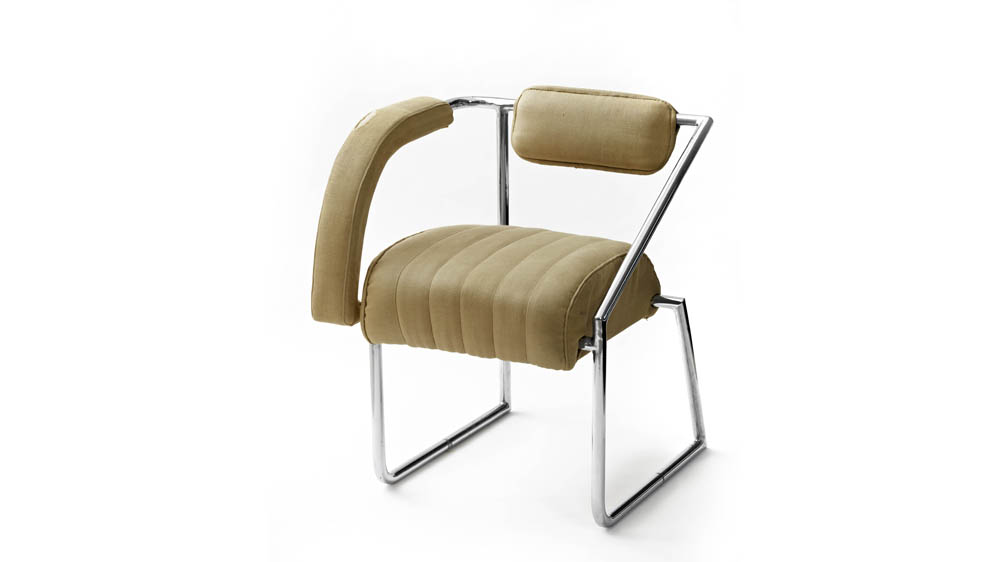
DB: I think it was interesting just to see how there are so many artefacts I just walked past that I would never have thought there was an LGBTQIA+ history in there. I always think of that Eileen Gray chair. I remember when we walked around and El was saying what’s interesting is, the way the chair is designed. It's almost like a chair for slouching and not sitting straight.
ER-B: As a design feature, yes, it was so you could lean in a certain way, and it was a customisable design so that depending on if you were left dominant or right dominant, you could design the chair for you. I was trying to find something that wasn't an anecdotal, trash essay about it. And I had found an article about how, in the golden Hollywood era, during the time of the Hays Code, sitting was really policed in certain ways because of how gender could be conveyed with how you sat. For example, a woman shouldn't be sitting with her legs wide open, because that's masculine. If a man crossed his legs, that meant he was feminine. What my research now is closer to, is how design choices are made to constrict people or to enable people to move freely in certain ways. When you think about a chair, that's such a mundane, normal object, it does actually make us all conform and sit in a certain way.
EG: The tour guides- I would imagine for some of them, this was a different type of history than that they would be used to telling. Was there anything that you felt was key to get across to them?
DB: One of the first things that we wanted to do was to get them training on it, so that we felt they’d be more comfortable with it. We never felt the guides would be uncomfortable giving the tour, but it was more just getting the rhetoric right. We reached out to a charity called Shout Out, who came in, gave us a day of training. So, I think that was the number one key thing for us, and also having our guides prepared that if for any reason there was any kind of negative reaction, that they'd be able to handle it. And if they had any questions about anything that they could come to us with it. But we're very lucky with our guides panel- they’re really passionate about telling these stories.
ER-B: I think it was about making sure they didn't feel scared. All of us have had the conversation that we don't want it to feel like this is only for the LGBTQIA+ community to attend. All of our histories need to be shared in the same way. I think Changing Ireland does that really well; that you have so many different perspectives and artefacts from different communities that are all in one place. We gender the objects; we sexualize the objects. So if we want to shift that a little bit and make that a little bit weird, does that tell us a different story? It’s such a social thing to give objects meaning and we're all involved in that process.
Participant Feedback
“It was clear that a lot of work has been done by him [the tour guide] to ensure our stories are told not only with great knowledge, but great care and sensitivity also. Thank you for the tour!”
EG: In terms of responses and feedback, Diarmuid, and what the tour guides have been saying, how have things been going to your knowledge?
DB: We launched the tour, as I said, to mark the 10th anniversary of Marriage Equality, and on that day, the Barracks was hosting a large event called What a Difference A Day Made, which was a big celebration. We'd over 200 people on the tours, vast majority of them from the LGBTQIA+ community and what was lovely was there were a lot who were like “this is great, I would say this instead”, “I see what you mean here but I would prefer this”, so we got lovely feedback there. Since we've opened it, we've been very clear that it's not a tour solely for the LGBT community. It is everyone's history. We run it [the tour] on the first Saturday every month. And the feedback has been overwhelmingly positive.
Participant Feedback
“A hugely interesting (and at times surprising) tour showing the often-erased queer history of Ireland”
EG: Do you think there's been a specific demographic in terms of age attending?
DB: On Culture Night I put on two LGBTQIA+ tours in the evening. And both tours were completely oversold. And I remember that was quite a young audience. But it's worth saying we've had older groups coming in, we've had older members of the public on the public tours that we hold during the week.
ER-B: And I think like it's really nice that it's a younger crowd too, because there can be discourse sometimes in community that “these young people don't know what we went through”. And I think that each generation of queer communities have their own different challenges, and it's so changeable with politics. I think that there is a real drive in younger generations of communities to know their history and they're really supportive and empathetic in ways that I didn’t see when I was growing up, when there was no visible LGBTQIA+ community around.
DB: And museums are public spaces. They are for everyone and there is definitely a thing about younger people maybe not engaging as much with them. And if it's a case that there's younger members of the LGBTQIA+ community who now see the Museum as a place where they can come, because their history is being told, I think that's hugely beneficial.
.jpg "Iodine-Bottle-(1).jpg")
EG: That leads on to the last question- how do you hope visitors will feel after they've taken this tour?
ER-B: I suppose I want people to leave feeling moved in some way. You want people to feel, I suppose, empowered and I think that kind of goes back to what Diarmuid had said, “wanting people to feel like they're part of not just an institution but a national institution”.
To attend a Museum LGBTQIA+ tour, see here for monthly dates and times.
To learn more about this tour, and the research project which informed its creation, click here.