By Keisha-Paige Plant
Munster Technological University student, BSc (Hons) in Wildlife Biology
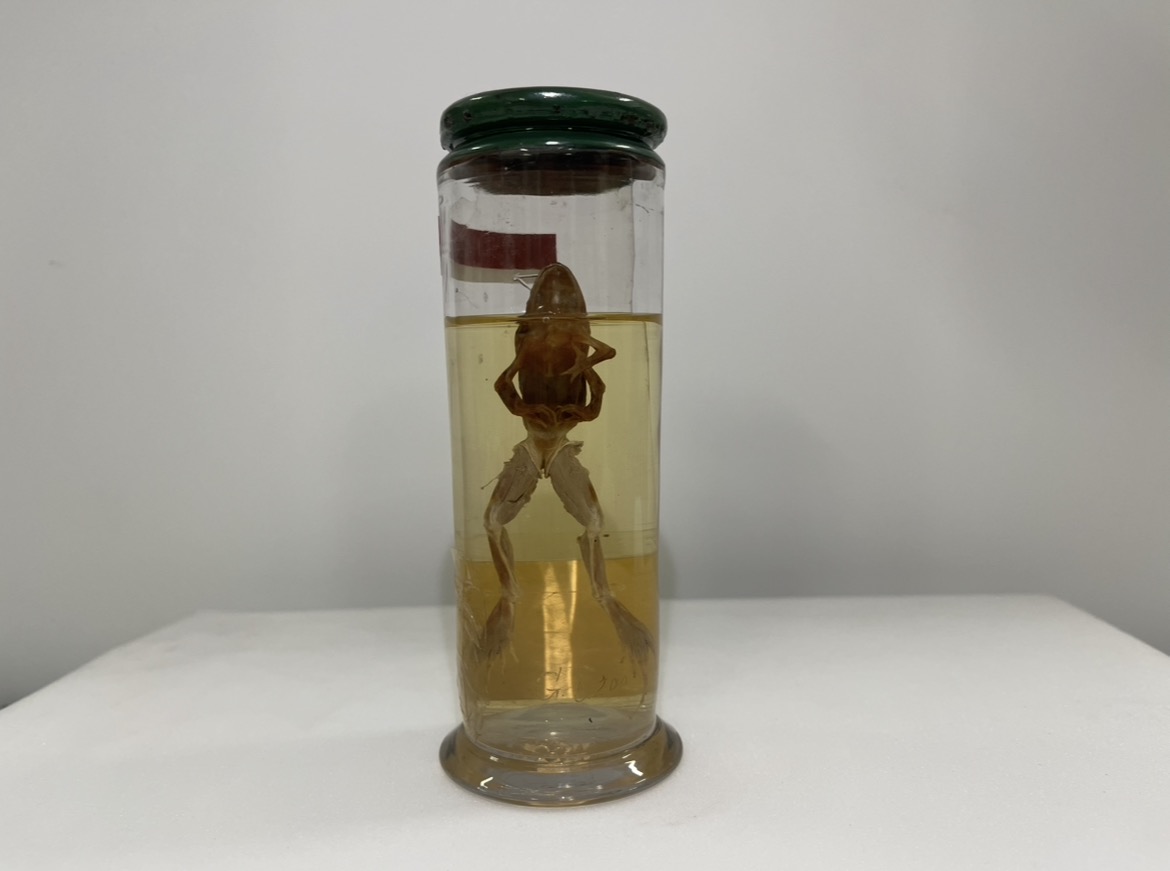
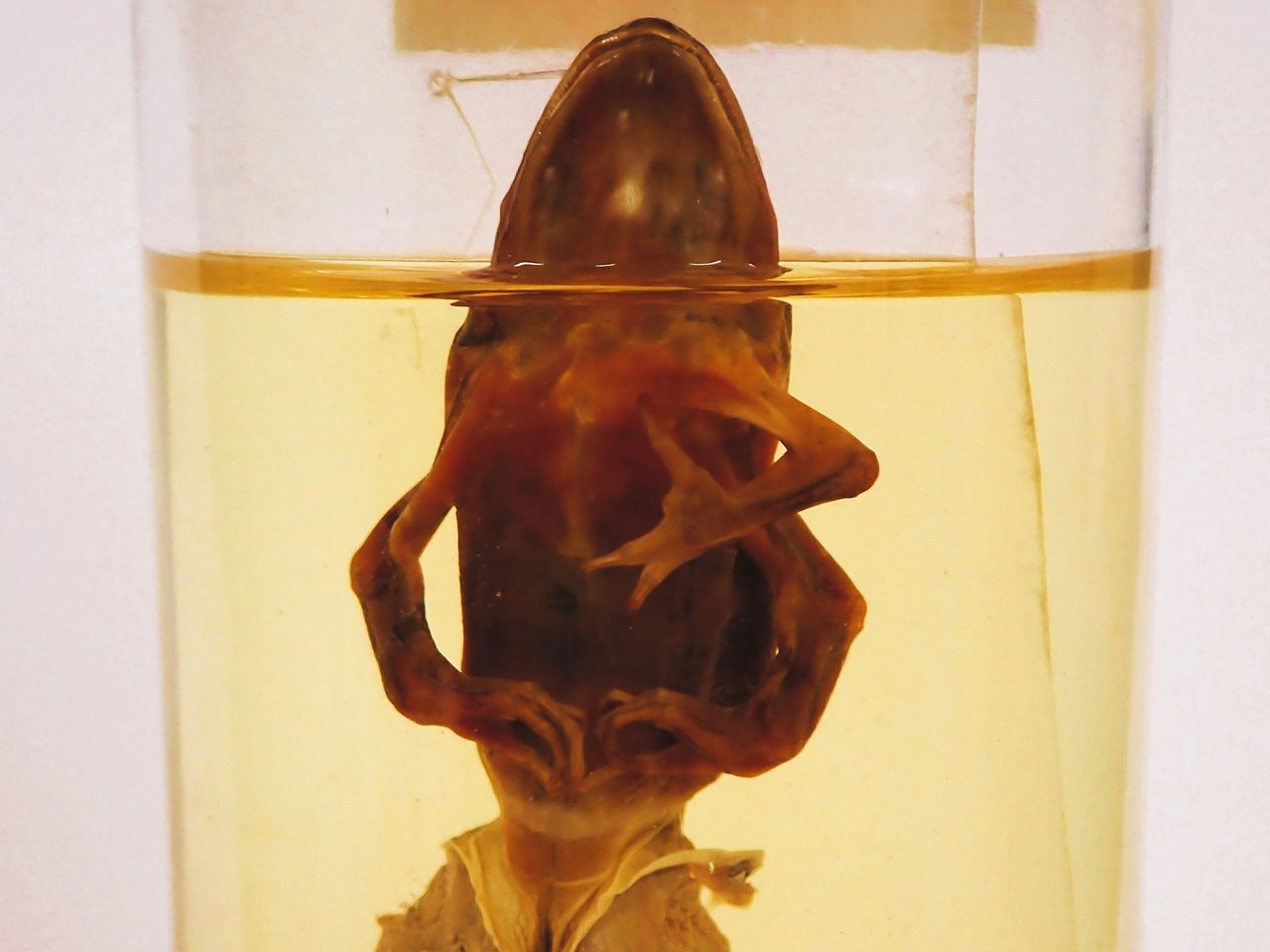
Having chosen the National Museum of Ireland Natural History Division for my third-year Wildlife Biology work placement, I thought I knew what I would be getting into: specimen handling, fluid preservation, data refinement, collection care, etc. However, actually stepping inside the collections was a bit different to what I expected. I found myself surrounded by shelves lined with wet specimens suspended in glass jars, snapshots of species and moments that would otherwise have been lost to time. From a two-headed kitten to eels choking on other eels, I was fascinated working with such incredible specimens. Among the countless preserved animals hidden behind the scenes, one specimen caught my eye: a frog with five legs.
Initially unassuming, with its greenish-brown skin, webbed feet, and the unmistakable silhouette of a common frog. Yet, upon further inspection, one might notice the extra leg nestled just above its forelimbs, giving the impression that Mother Nature may have miscounted when assigning this particular amphibian its appendages.
Specimen information:
NMINH:2022.5.25 Frog from a collection of various animal specimens donated by Royal College of Surgeons Ireland. Many of which were zoological specimens from the historic museum from 1834. The specimen’s label reads: “1 specimen Frog with 2 left fore limbs in glass jar. This specimen was in the Museum of St. Peter Street School.”
The Big Question
“Why does it have five legs?” would be the natural and expected response to finding such a creature. So I set out to answer that. As it turns out, deformities like this have been recorded in frog populations, across the world, for decades. During the 1990s, reports of frogs with extra or missing limbs, and twisted bones, began appearing throughout wetlands in North America. Unsurprisingly, people were alarmed. Mutant frogs emerging from local ponds sounded more like a mediocre science fiction movie plot than an ecological wonder. However, the reality of it was both less dramatic and somehow even stranger.
One major cause behind these deformities’ lays in the presence of a tiny parasite called Ribeiroia ondatrae during the frog’s embryonic stage (Johnson et al., 2001). This parasitic flatworm, known as a trematode, has a pretty complicated life cycle involving freshwater snails, tadpoles, and birds. The parasite infects snails before it moves into developing tadpoles, where it settles near the areas that will eventually form limbs (Johnson and Sutherland, 2003). This is where trouble begins.
As the tadpole grows, the parasite can interfere with normal limb growth, sometimes causing frogs and toads to develop extra limbs, missing legs, or severely malformed bones (Johnson et al., 2001). Whether or not this specimen is a victim of this parasite, has not been confirmed. Further research is required to prove this.
Unfortunately for the frog, the deformity is not just cosmetic. Amphibians with malformed limbs are often less skilled at swimming, jumping, or escaping predators. From the parasite’s perspective, this fault could be very useful. Scientists believe infected amphibians may be more likely to be eaten by birds. Therefore, the parasite’s life cycle is able to continue in its next host (Johnson and Sutherland, 2003).
The importance of amphibian research
Strange frogs like this are more than biological curiosities. Frogs are highly sensitive to pollution and habitat disturbance, making them useful ecosystem indicators (Blaustein and Johnson, 2003). Nutrient pollution can increase snail populations, helping parasites, like this flatworm, spread more successfully (Johnson and Sutherland, 2003). In this way, one extra frog leg may reveal a much larger story about wetland health.
Specimens like this also illustrate the importance of museum collections. What first appears to be an unusual curiosity preserved in a jar can become a valuable scientific record, helping researchers study biodiversity, diseases, and environmental changes decades later.
More Information
If you want to read more about work placements in the National Museum of Ireland, please check Jessica Foley’s article in the Registration Corner: Registration Corner | National Museum of Ireland
To learn more about the National Museum of Ireland’s, Natural History Collection you can visit the Dead Zoo Lab at the National Museum of Ireland, Collins Barracks site. Admission is free. Or explore the collection online here.
References
Blaustein, A. R., and Johnson, P. 2003. Explaining Frog Deformities. [Online] Available at: <(PDF) Explaining Frog Deformities> (Accessed: 18 May 2026)
Johnson, P., Lunde, K., Haight, R. W., and Bowerman, J. 2001. Ribeiroia ondatrae (Trematoda: Digenea) infection induces severe limb malformations in western toads (Bufo boreas). [Online] Available at: <(PDF) Ribeiroia ondatrae (Trematoda: Digenea) infection induces severe limb malformations in western toads (Bufo boreas)> (Accessed: 18 May 2026)
Johnson, P. and Sutherland, D. 2003. Amphibian deformities and Ribeiroia infection: an emerging helminthiasis. [Online] Available at: <Amphibian deformities and Ribeiroia infection: an emerging helminthiasis - ScienceDirect> (Accessed: 18 May 2026)